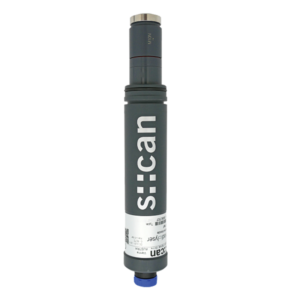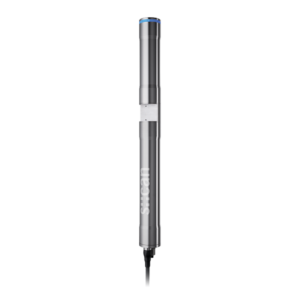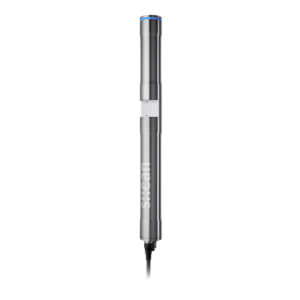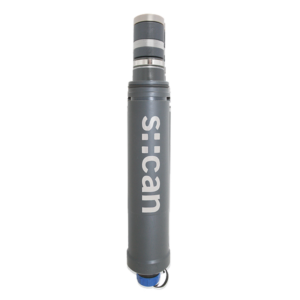

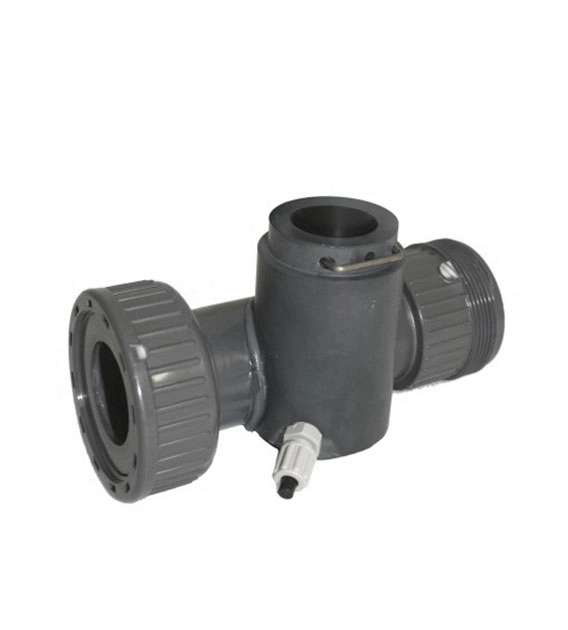
Probe flow fitting, PVC (waste water)
Impeller-type probe flow fittings are designed for use with PVC piping in wastewater and industrial applications, which use a non-magnetic sensing mechanism to provide accurate and reliable flow data. These sensors are designed for easy installation in a variety of pipe sizes.
- Fitting Type: Available as probe/insertion style sensors that are installed into a pipe via a saddle or fitting, or as pre-assembled PVC Tee type sensors.
- Wastewater Suitability: Best suited for relatively clean wastewater, as the mechanical impeller can be susceptible to fouling by heavy debris, though the forward-swept design helps mitigate this.
- Non-Magnetic Sensing: Feature a proprietary non-magnetic sensing mechanism, which provides improved accuracy and is less prone to interference from metallic particles often found in industrial systems.
- Material: The wetted parts and housing are often made of durable plastic or PVC (e.g., glass-filled plastic or polypropylene) with Viton seals, offering corrosion resistance.
- Outputs: Transmit a low impedance square wave signal with frequency proportional to flow rate, easily integrated with controllers or data loggers.
- Easy Installation: Designed for easy installation, including hot-tap versions that allow insertion or removal under pressure.
- Wastewater and Sewage Treatment: This is a primary application due to PVC’s exceptional resistance to corrosion from the acids, alkalis, salts, and other chemicals commonly found in sewage and industrial wastes. The smooth interior walls of PVC pipes and fittings also help minimize friction, prevent the buildup of scale or debris, and maintain high flow capacity, which is crucial for efficient waste management systems.
- Drainage Systems: PVC has largely replaced traditional materials like cast iron for both residential and commercial drainage, including waste pipes, drainpipes, gutters, and downspouts. They are designed for non-pressure, gravity-based flow applications.
- Industrial Processes: In industrial settings, flexible and rigid PVC shrugs off various acids, caustics, and solvents that would otherwise damage metal pipes. They are used for chemical processing and ventilation systems.
- Irrigation and Water Supply (Cold Water): PVC is widely used in irrigation, pool and spa plumbing, and potable (drinking) water supply lines due to its non-toxic nature, resistance to chlorine and other chemicals, and ability to handle consistent flow. These applications typically involve cold water pressure distribution systems, as standard PVC has a maximum operating temperature around 140°F (60°C).
- Electrical Conduits: PVC piping is also used to house and protect electrical wiring in residential and commercial settings, providing insulation and resistance to moisture and physical impacts.
- Series 200 (Model 220PVS):
- Fittings: 2-inch NPT thread for saddle mount
- Wetted Materials: Non-metallic (PVC sensor sleeve, Zirconia ceramic shaft, nylon impeller)
- Pipe Size: 3 inches and up (saddle required)
- Flow Range: 0.5–30 ft/sec (recommended design)
- Max Pressure: Up to 100 PSI @ 100°F
- Max Temperature: 140°F (60°C) continuous
- Accuracy: ±1.0% of full scale
- Output Signal: Low impedance square wave, frequency proportional to flow rate, can travel up to 2000 ft
- Series 228PV (PVC Tee):
- Fittings: 1-1/2 to 4 inch PVC Tee (socket weld)
- Wetted Materials: PVC body (Radel® R body on some models), Zirconia ceramic shaft, nylon impeller
- Pipe Size: 1-1/2 to 4 inches
- Flow Range: 0.5–30 ft/sec (recommended design)
- Max Pressure: Up to 100 PSI
- Max Temperature: 110°F (43°C) continuous
- Accuracy: ±1.0% of full scale
- Output Signal: Low impedance square wave (8 V DC), can travel up to 2000 ft