SCADA is the system that gives industries visibility and control over complex, continuous operations by collecting live data from sensors, presenting it in clear visual dashboards, raising alarms when issues occur, and enabling operators to act from a central location. It works like a nervous system where sensors sense, PLCs react, networks communicate, and SCADA software informs decisions. Born out of the need to manage large, remote, and high-risk industrial processes, SCADA has evolved from isolated control rooms into modern, connected platforms with real-time access, analytics, and integration with IT systems. Today, SCADA does not replace PLCs or HMIs but unifies them, helping industries reduce downtime, improve safety, and move from reactive control to predictive, data-driven operations.
What SCADA Really Is (Without the Complexity)
At its core, SCADA is about awareness and control.
Industrial processes are fast, continuous, and often spread across large areas. Machines generate enormous amounts of data, far too much for humans to track manually. SCADA exists to solve this problem.
A SCADA system:
- Collects live data from machines and sensors
- Displays that data in a visual, human-readable way
- Alerts operators when something goes wrong
- Allows corrective action from a central location
In simple terms:
SCADA is how industries “see” and “steer” their operations.
Without SCADA, operators would be blind to what is happening inside their systems until failures occur.
Why SCADA Became Necessary
Before SCADA, industrial control was mostly manual.
Operators stood in front of panels filled with switches, dials, and indicator lights. If a pump failed at a remote location, someone physically had to travel there to identify the problem. As industries expanded, this approach became slow, expensive, and risky.
As processes grew:
- Facilities became larger
- Equipment became more complex
- Downtime became more costly
SCADA emerged as a way to centralize visibility and decision-making, allowing a small team to oversee massive systems efficiently.
How a SCADA System Works (Think of It as a Nervous System)
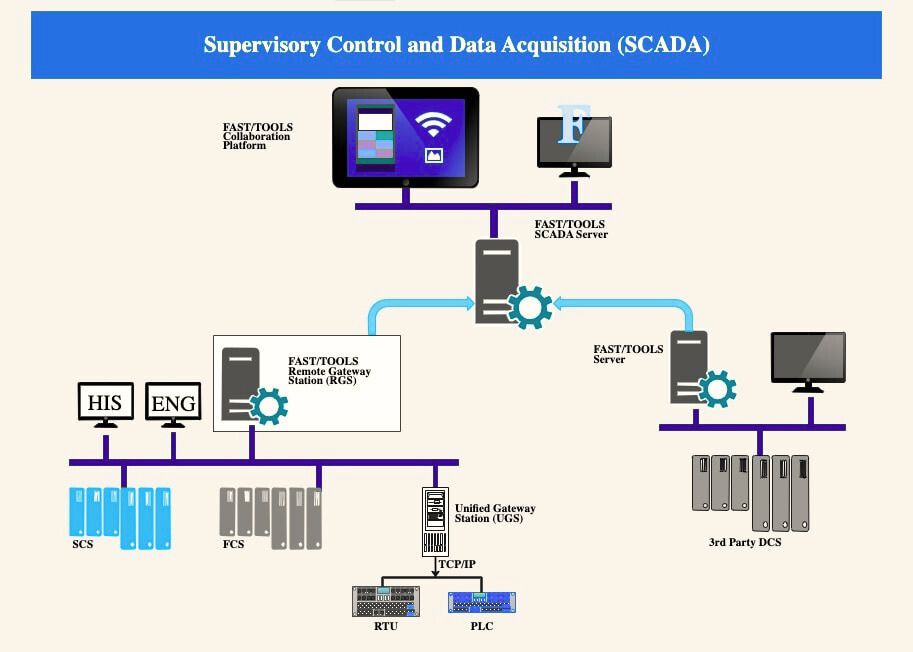
To understand SCADA, it helps to think of it like the human nervous system.
Sensors and Field Devices
These are the “senses.”
They measure temperature, pressure, flow, speed, voltage, and more.
Controllers (PLCs or RTUs)
These are the “reflexes.”
PLCs and RTUs read sensor data and directly control machines such as motors, valves, and pumps.
Communication Networks
These are the “nerves.”
They transmit data from the field to the control center.
SCADA Software and HMI
This is the “brain and eyes.”
Operators see live data, trends, alarms, and system status through graphical screens.
When something abnormal happens, SCADA doesn’t just show data.
It tells operators where to look and when to act.
A Simple Real-World Example
Imagine a water treatment plant.
Thousands of sensors monitor flow rates, chemical levels, tank volumes, and pump health. If one pump begins to fail, SCADA immediately flags the issue on the operator’s screen.
The operator can:
- Pause the process
- Adjust parameters
- Switch to a backup pump
- Prevent water loss or contamination
Without SCADA, the failure might only be noticed after damage is done.
Who Uses SCADA and Why It’s Everywhere
SCADA is used wherever systems must run continuously and safely.
You’ll find SCADA in:
- Manufacturing plants
- Power generation and distribution
- Oil and gas pipelines
- Water and wastewater facilities
- Transportation systems
- Food and beverage production
Even if you don’t see it, SCADA likely supports the services you rely on daily.
How SCADA Has Evolved Over Time
SCADA did not appear fully formed. It evolved alongside technology.
Early SCADA
Early systems were large, isolated, and expensive. They ran on mainframe computers and served single facilities.
Distributed SCADA
As computers became smaller, SCADA systems spread across multiple machines within a plant, improving reliability and performance.
Networked SCADA
With Ethernet and open protocols, SCADA systems could finally communicate across vendors and locations.
Modern SCADA
Today’s SCADA systems integrate industrial control with modern IT tools such as databases, web applications, and secure remote access.
This evolution transformed SCADA from a control tool into a decision-support system.
What Makes Modern SCADA Different
Modern SCADA systems are no longer confined to control rooms.
They offer:
- Real-time access from anywhere
- Web and mobile dashboards
- SQL-based data storage
- Easy integration with MES and ERP systems
- Advanced reporting and analytics
This allows organizations to move beyond reactive control toward predictive and optimized operations.
How SCADA Fits with PLCs and HMIs
SCADA does not replace PLCs or HMIs.
Instead, it connects them into a larger picture.
- PLCs execute control logic
- HMIs allow local machine interaction
- SCADA provides system-wide supervision and insight
Together, they form the foundation of modern industrial automation.
Where SCADA Is Headed Next
As industries become more data-driven, SCADA continues to evolve.
Future-focused SCADA systems emphasize:
- IIoT connectivity
- Edge and cloud integration
- Cybersecurity
- Advanced visualization
- Smarter alarms and analytics
SCADA remains relevant because it adapts while staying grounded in reliability and simplicity.
SCADA Solutions by Aaxis Nano
At Aaxis Nano, we design SCADA systems that don’t just display data, but help operators make better decisions.
Our SCADA expertise includes:
- SCADA system design and architecture
- PLC and SCADA integration
- Custom HMI development
- Data logging, reporting, and dashboards
- System upgrades and modernization
- Remote monitoring and IIoT enablement
If your operation needs clearer visibility, faster response, and scalable control, we help you build SCADA systems that work today and grow tomorrow.
👉 Talk to Aaxis Nano to design a SCADA system tailored to your industrial needs.

