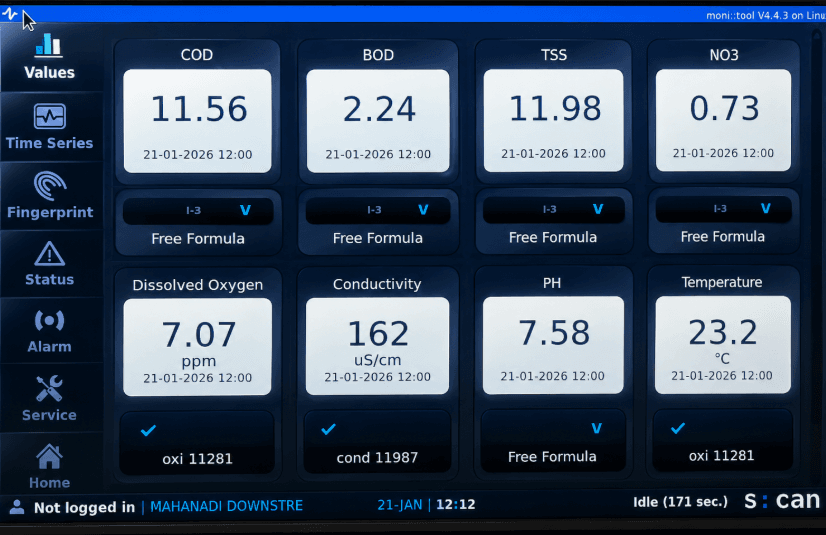
Groundwater Depletion vs. Groundwater Contamination: Why Monitoring Strategy Differs for Each Groundwater problems in India tend to get lumped into a single headline – “groundwater crisis” – but from an engineering and compliance standpoint, they are two separate problems that require two separate monitoring strategies. Groundwater depletion is a quantity problem: how much water is left, and how fast is it being drawn down. Groundwater contamination is a quality problem: what’s dissolved or suspended in the water that’s still there. Treating them as one problem, or monitoring for one while assuming it covers the other, is one of the most common design mistakes in industrial and municipal water compliance programs. This guide breaks down the technical difference, the parameters and instrumentation each requires, and how to structure a monitoring network that actually covers both. What Is Groundwater Depletion? Causes and Key Indicators Groundwater depletion refers to a sustained decline in the water table due to extraction rates exceeding natural or artificial recharge. In India, this is driven primarily by agricultural pumping, urban borewell proliferation, and reduced recharge from paved surfaces and reduced monsoon infiltration. Key indicators tracked in a depletion-monitoring program include: Static water level (SWL) – the depth to water when no pumping is occurring, typically measured in meters below ground level (mbgl) Dynamic/pumping water level – the drawdown level during active extraction, used to calculate specific capacity Rate of decline (m/year) – trended over multiple years to identify aquifers approaching critical stress Recharge rate – estimated from rainfall infiltration data and cross-referenced against extraction volumes None of these parameters says anything about whether the water is safe to drink or use industrially – which is exactly why depletion monitoring and contamination monitoring require different sensor sets. What Is Groundwater Contamination? Common Sources and Pollutants Groundwater contamination refers to the presence of chemical, biological, or physical pollutants at concentrations that exceed permissible limits for drinking, agricultural, or industrial use. Common sources in the Indian context include: Geogenic contamination – naturally occurring fluoride, arsenic, and iron leaching from bedrock, especially prevalent in central and southern peninsular India Agricultural runoff – nitrate from fertiliser overuse, a major contributor to groundwater nitrate levels in Punjab, Haryana, and parts of UP Industrial effluent seepage – heavy metals, hydrocarbons, and organic compounds from unlined effluent pits or leaking underground storage Sewage infiltration – coliform and pathogenic contamination in areas with unlined soak pits near shallow aquifers Quantity vs. Quality: Why the Two Problems Need Different Monitoring Approaches Aspect Depletion Monitoring Contamination Monitoring What’s measured Water level (mbgl) Chemical/biological parameters (TDS, nitrate, fluoride, coliform) Primary instrument Pressure transducer / piezometer Multi-parameter water quality probe Data frequency Often adequate at daily/weekly intervals Often requires continuous or high-frequency sampling, especially near contamination sources Regulatory driver CGWA extraction norms, Atal Bhujal Yojana CPCB/BIS drinking water standards, industrial NOC conditions Failure mode if ignored Aquifer collapse, land subsidence, dry borewells Health hazards, regulatory penalties, loss of usable water source A facility that only tracks water level compliance can still be sitting on a contaminated aquifer without knowing it — and vice versa. A complete monitoring strategy runs both in parallel, often on the same physical borewell network but with distinct instrumentation stacks. Sensors and Parameters for Depletion Monitoring (Water Level, Piezometers, Recharge Rate) A standard depletion-monitoring network is built around: Piezometers fitted with submersible pressure transducers for continuous static/dynamic water level logging Telemetry units (GSM/GPRS/cellular) to push readings to a central dashboard without manual site visits Rain gauge integration to correlate recharge events with water level recovery Automated alerting when water levels cross a defined critical threshold, often tied to CGWA reporting obligations Sensors and Parameters for Contamination Monitoring (TDS, Nitrate, Fluoride, Heavy Metals) A contamination-monitoring network is built around a different instrumentation stack: TDS/conductivity sensors for a first-pass indicator of dissolved mineral load Ion-selective electrodes (ISE) for nitrate and fluoride — the two most widespread contaminants in Indian groundwater pH and ORP probes to flag chemical imbalance or industrial seepage Turbidity sensors where surface infiltration or sediment intrusion is suspected Periodic lab-verified sampling for heavy metals and microbiological parameters that real-time sensors cannot yet reliably capture continuously Regulatory Framework in India: CGWA Norms and Atal Bhujal Yojana The Central Ground Water Authority (CGWA) regulates groundwater extraction through No Objection Certificates (NOCs) for industrial and infrastructure projects, with conditions often mandating installation of piezometers and periodic water level reporting. The Atal Bhujal Yojana (ABY), a central government scheme, pushes community-level groundwater monitoring and management in water-stressed districts, and increasingly expects digitized, telemetry-based reporting rather than manual gauge readings. Separately, water quality compliance for industries typically falls under state Pollution Control Board conditions and BIS IS 10500 drinking water standards – a distinct regulatory track from CGWA’s extraction-focused mandate. How to Choose the Right Monitoring Strategy for Your Site or Facility A practical framework for deciding where to invest monitoring budget: Industrial sites near effluent handling areas – prioritise contamination monitoring; depletion is secondary unless extraction volumes are also high High-extraction agricultural or municipal supply zones – prioritise depletion monitoring with automated water-level telemetry Sites with both high extraction and contamination risk (common in industrial clusters) – a combined network is non-negotiable; regulators increasingly expect both data streams from a single site Aaxis Approach/Solution Aaxis Nano designs groundwater monitoring networks according to the specific risks and regulatory requirements of each site. Depletion-focused systems integrate digital water-level recorders, pressure-based level sensors, data loggers and telemetry to continuously track groundwater levels, drawdown, recovery and long-term aquifer trends.For contamination-focused monitoring, multi-parameter instruments can measure selected in-situ indicators such as temperature, pH, electrical conductivity, dissolved oxygen, ORP and turbidity. Contaminant-specific parameters may additionally require periodic sampling and laboratory analysis. In combined networks, continuous field measurements and verified laboratory results can be consolidated through a common data platform for trend assessment, threshold alerts and reporting.Using proven groundwater monitoring instrumentation from technology partners – In-Situ, OTT HydroMet and Sommer Messtechnik, Aaxis Nano provides system engineering, installation, commissioning, telemetry integration, dashboard configuration, and lifecycle support across