

Electromagnetic flowmeters, often called magnetic flowmeters or magmeters, are among the most reliable and widely used instruments for measuring the flow of conductive liquids in industrial pipelines.
They are trusted in critical applications not because they are complex, but because their operating principle is fundamentally stable, linear, and unaffected by fluid density, viscosity, or pressure. This makes electromagnetic flowmeters a preferred choice wherever accuracy, durability, and low maintenance are essential.
This guide explains what electromagnetic flowmeters are, how they work, where they are used, and when they should or should not be selected, in a clear and practical way.
What Is an Electromagnetic Flowmeter?
An electromagnetic flowmeter is a device used to measure the flow rate of electrically conductive liquids flowing through a closed pipe.
Unlike mechanical flowmeters, electromagnetic flowmeters have:
- No moving parts
- No obstruction in the flow path
- No pressure drop
Instead of relying on mechanical motion, they use a fundamental law of physics known as Faraday’s Law of Electromagnetic Induction to measure flow.
In simple terms:
If a conductive liquid moves through a magnetic field, a voltage is generated.
The faster the liquid moves, the higher the voltage.
This voltage is directly proportional to the flow velocity.
Why Electromagnetic Flowmeters Are So Reliable
Many flow measurement technologies struggle when process conditions change. Variations in temperature, pressure, density, or viscosity can introduce errors.
Electromagnetic flowmeters avoid these issues because:
- The measurement depends only on fluid velocity
- The magnetic field and pipe diameter are fixed
- The output signal remains linear across a wide flow range
This is why electromagnetic flowmeters maintain accuracy even in dirty, corrosive, or slurry-based applications.
How Does an Electromagnetic Flowmeter Work?
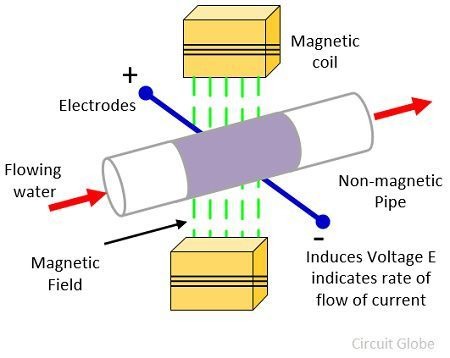
An electromagnetic flowmeter consists of four main elements working together:
1. Flow Tube
The liquid flows through a lined pipe section called the flow tube. The liner electrically isolates the fluid from the pipe body and protects against corrosion or abrasion.
2. Magnetic Coils
Coils mounted outside the flow tube generate a controlled magnetic field across the pipe.
3. Electrodes
Two electrodes are positioned opposite each other on the inner wall of the flow tube. As the conductive liquid passes through the magnetic field, a voltage is induced and detected by these electrodes.
4. Transmitter
The transmitter converts the detected voltage into a flow signal and outputs it as:
- 4–20 mA
- Pulse or frequency
- Digital communication (HART, Modbus, Profibus, etc.)
Because the magnetic field strength and pipe diameter remain constant, the relationship simplifies to:
Voltage ∝ Flow Velocity
This linear behavior allows electromagnetic flowmeters to achieve excellent accuracy and repeatability.
What Types of Liquids Can Be Measured?
Electromagnetic flowmeters can measure any liquid with sufficient electrical conductivity, including:
- Water (potable, raw, treated)
- Wastewater and sewage
- Slurries and sludge
- Acids and alkalis
- Chemical solutions
- Food and beverage liquids
- Pulp and fiber-laden fluids
As long as the minimum conductivity requirement is met, the measurement remains accurate and stable.
Where Electromagnetic Flowmeters Are Commonly Used
Water and Wastewater Treatment
Electromagnetic flowmeters are ideal for raw water, treated water, sludge, and chemical dosing. Their resistance to debris and lack of pressure loss make them especially suitable for municipal systems.
Chemical and Process Industries
Because there are no moving parts and the liner materials can resist aggressive chemicals, magmeters perform reliably in corrosive environments.
Food and Beverage Industry
Sanitary electromagnetic flowmeters are widely used for milk, beer, syrups, juices, and other hygienic liquids where cleanliness and accuracy are critical.
Mining and Mineral Processing
They handle abrasive slurries without mechanical wear, making them suitable for harsh mining conditions.
Power Generation
Used in cooling water and boiler feedwater systems where consistent flow measurement is essential for efficiency and safety.
Pharmaceutical and Biotechnology
Electromagnetic flowmeters support sterile designs and CIP/SIP processes, ensuring regulatory compliance and contamination-free measurement.
When Electromagnetic Flowmeters Are NOT the Right Choice
A key reason top-ranking pages earn trust is that they clearly explain limitations.
Electromagnetic flowmeters should not be used when:
- The fluid is non-conductive (oils, hydrocarbons, gases)
- Conductivity is near or below the minimum threshold
- Pipes are not completely full (unless using special designs)
- Proper grounding and installation cannot be ensured
Being aware of these constraints helps avoid incorrect selection and measurement errors.
Important Application and Sizing Considerations
To ensure accurate and reliable measurement, several practical factors must be considered:
Conductivity Margin
Do not size the meter too close to the minimum conductivity limit. Changes in fluid composition or temperature can reduce conductivity and cause signal loss.
Flow Velocity
Typical design velocity ranges between 2–3 m/s.
- Low velocities may allow solids to settle
- High velocities may increase liner wear in abrasive applications
Slurry Applications
For slurry service:
- Velocity must remain high enough to keep solids suspended
- Excessive velocity should be avoided to reduce abrasion
These trade-offs influence meter size and liner selection.
Advantages and Disadvantages of Electromagnetic Flowmeters
Advantages
- High accuracy and linear output
- No moving parts or pressure loss
- Suitable for dirty and corrosive fluids
- Minimal maintenance
- Long service life
Disadvantages
- Cannot measure non-conductive fluids
- Requires proper grounding
- Higher initial cost than simple mechanical meters
Understanding both sides ensures realistic expectations and correct application.
Integration With PLC and SCADA Systems
Electromagnetic flowmeters are designed for seamless integration into modern automation systems.
They commonly support:
- 4–20 mA analog output
- Pulse and frequency signals
- Digital protocols such as HART, Modbus, Profibus, and Ethernet-based networks
This allows direct connection to PLCs, SCADA, and IIoT platforms, enabling real-time monitoring, data logging, and process optimization.
Why Engineers Choose Electromagnetic Flowmeters
Engineers consistently select electromagnetic flowmeters because they:
- Deliver stable accuracy over time
- Handle challenging fluids reliably
- Reduce maintenance and downtime
- Provide predictable performance across a wide operating range
In long-term operation, the total cost of ownership is often lower than many alternative technologies.
How Aaxis Nano Supports Electromagnetic Flowmeter Applications
At Aaxis Nano, we help industries select, integrate, and optimize electromagnetic flowmeters based on real application requirements.
Our expertise includes:
- Flowmeter selection and sizing support
- Integration with PLC and SCADA systems
- Application-specific liner and electrode guidance
- Industrial automation and instrumentation solutions
- Commissioning and system optimization
Instead of offering generic products, we focus on correct measurement for real operating conditions.
👉 Speak with Aaxis Nano to ensure your electromagnetic flow measurement is accurate, reliable, and future-ready.

